

Garages · Calgary & Area
Garage Siding & Exterior Finishing
Garage siding, soffit, fascia and trim — matched to the house so the back of the property finally looks finished
Garages
Garage Siding & Exterior Finishing done right, the first time.
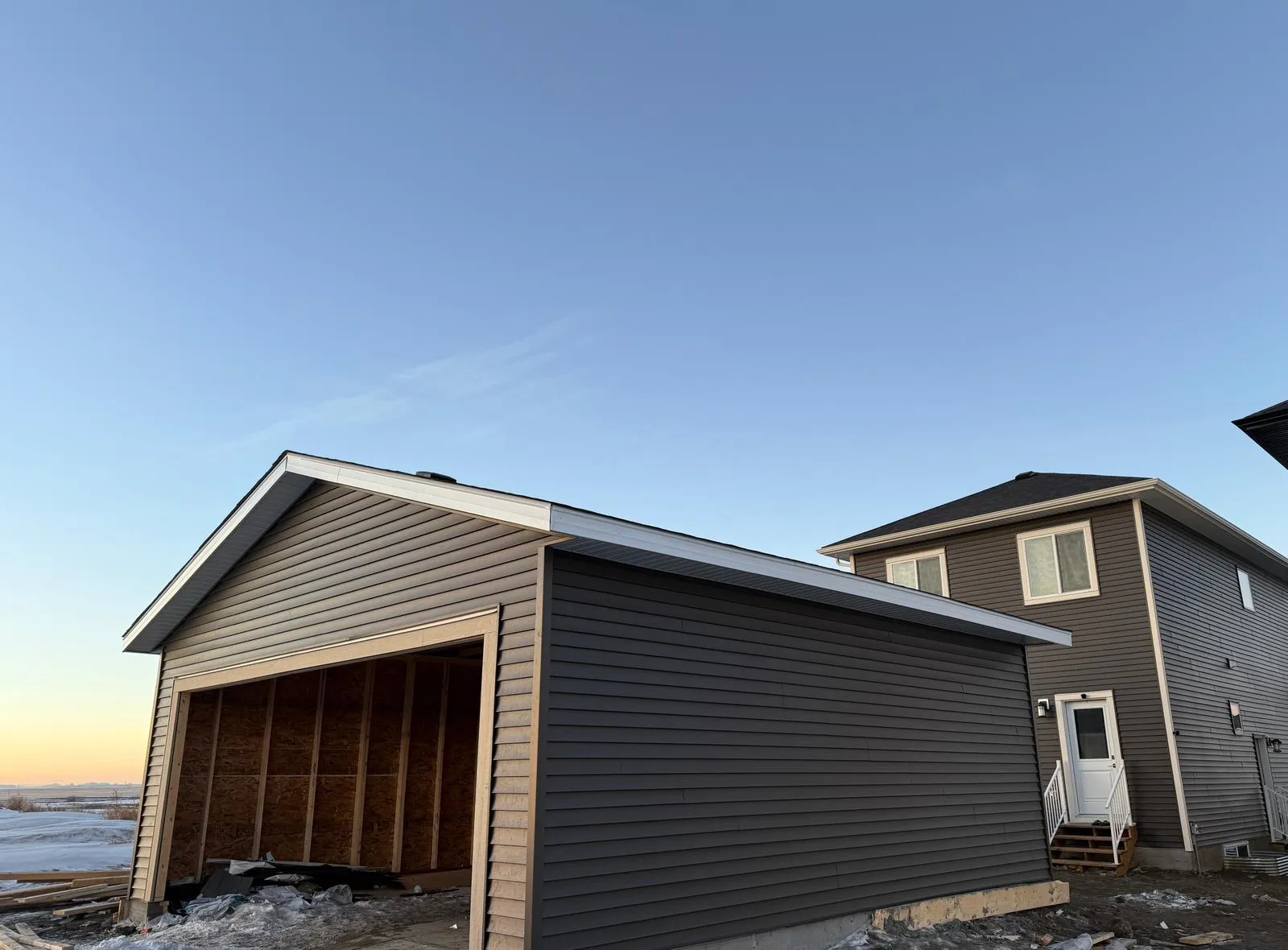
A detached garage finished in whatever was on sale reads as a shed. Finished in the same siding profile, colour, trim and eavestrough as the house, it reads as part of the property. We re-side garages in vinyl or James Hardie, replace the rotten sheathing and bottom plates that decades of runoff have caused, and complete the soffit, fascia and trim so the whole structure matches.
More about garage siding
Built for Calgary's weather & homes.
The detached garage is the building on a property that gets the least design attention and the most weather exposure at ground level. It sits on a lane or at the back of a yard, takes runoff off its own roof against the base of its walls, and is frequently clad in whatever was cheapest at the time — which is why so many otherwise well-kept Calgary properties have a garage that visibly does not belong to the house.
Re-siding it is one of the highest-impact, lowest-cost exterior jobs available. Matching the siding profile and colour, the trim, the soffit and fascia and the eavestrough to the house turns a structure that reads as a shed into one that reads as part of the property. On a lane-access lot where both buildings are seen from the same vantage, that difference is immediately visible.
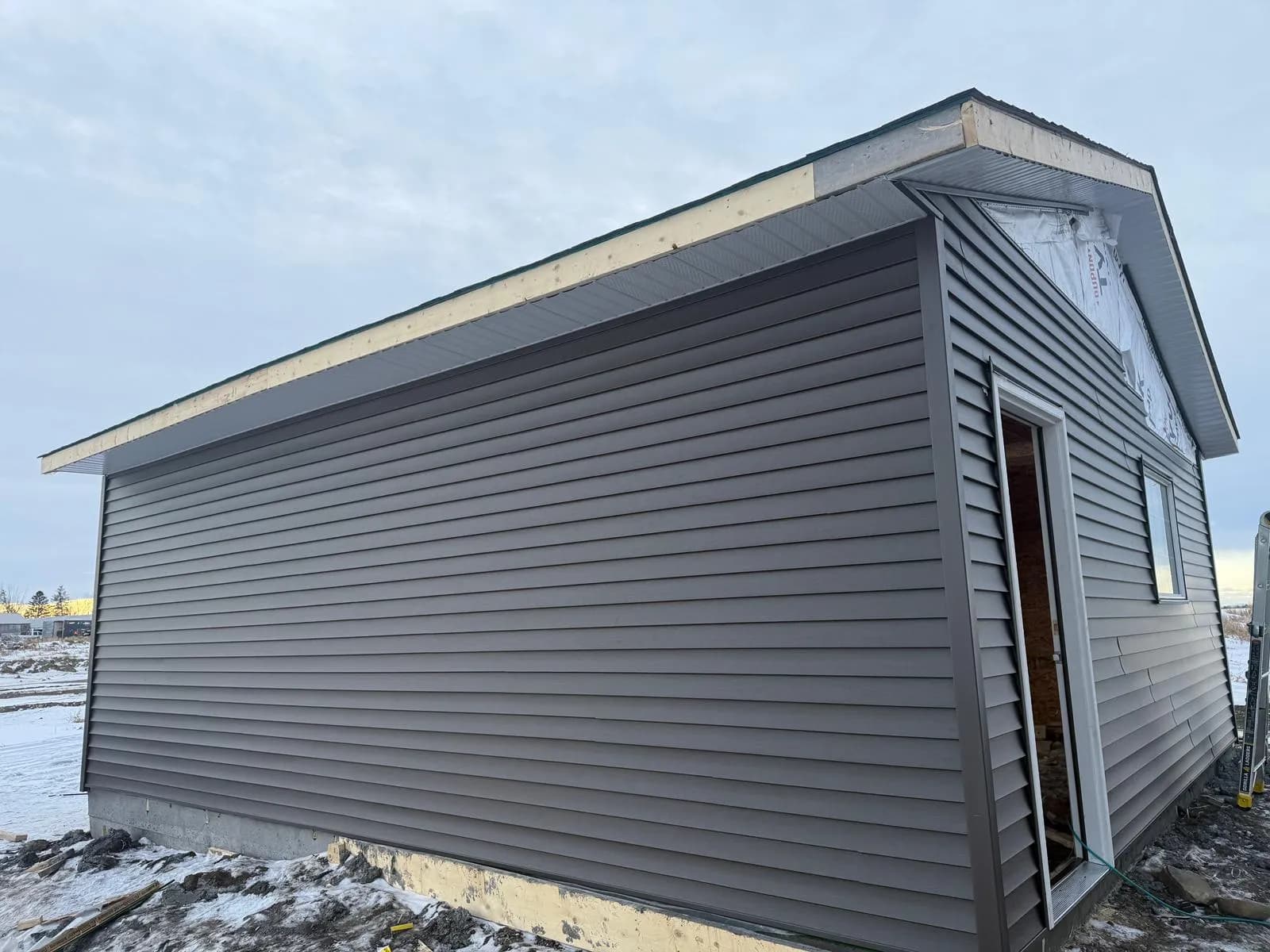
It is also frequently more than cosmetic. Garages without eavestrough — which is most of them — have been shedding water against the base of their walls for years. That means rotten sheathing at the bottom, rotten bottom plates, and sometimes framing that has taken damage. Cladding over that is the fast way to do the job and the wrong one, and we will open it up and tell you what is actually there.
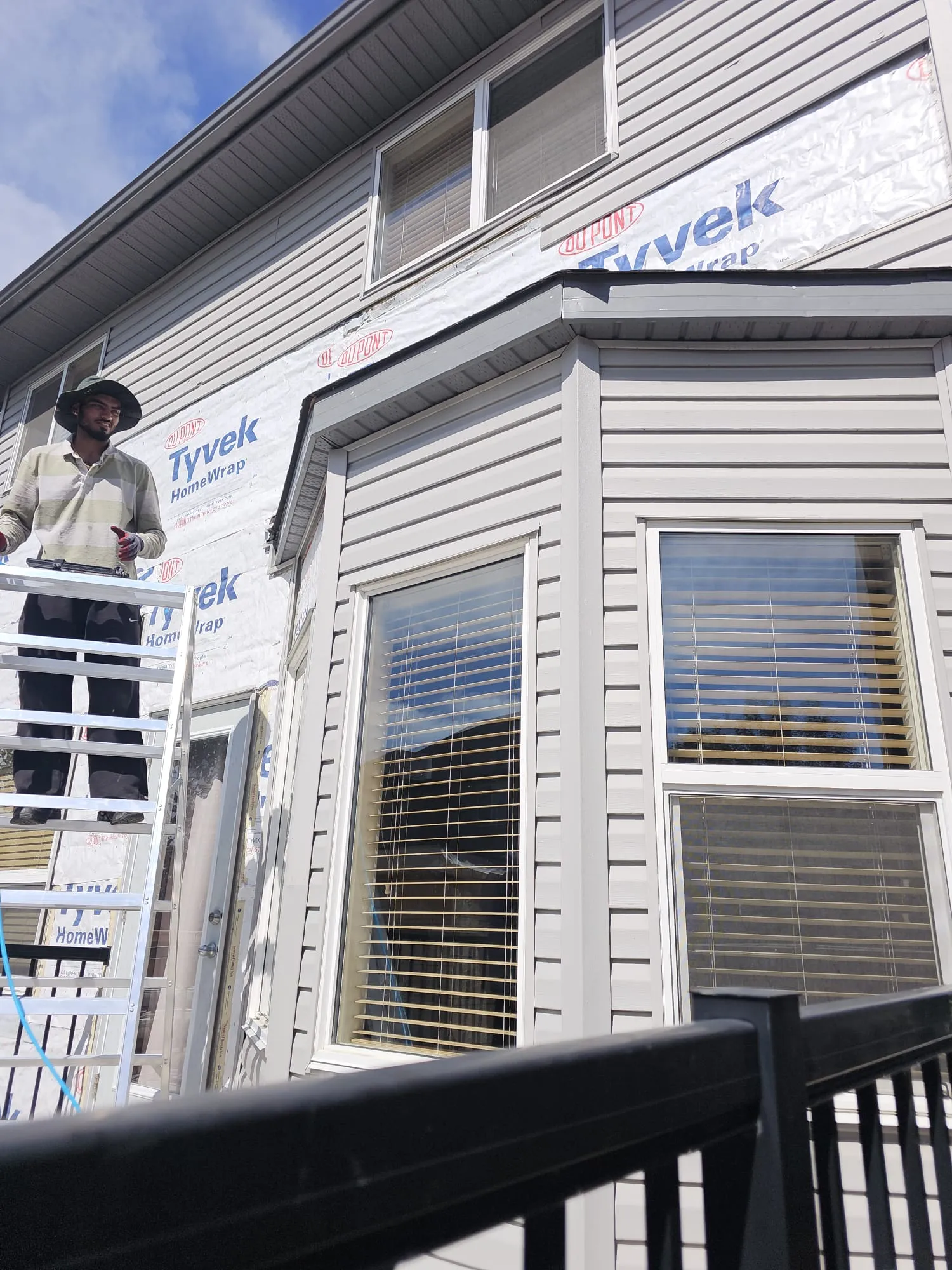
We side garages in vinyl, insulated vinyl and James Hardie fibre cement, with matched soffit, fascia and trim, and add seamless eavestrough where it is missing so the same problem does not start over. Across Calgary, Airdrie, Chestermere, Cochrane, Okotoks, High River, Langdon, Strathmore, Crossfield, Carstairs, Didsbury, Olds, Innisfail, Red Deer, Canmore, Drumheller and the surrounding counties.
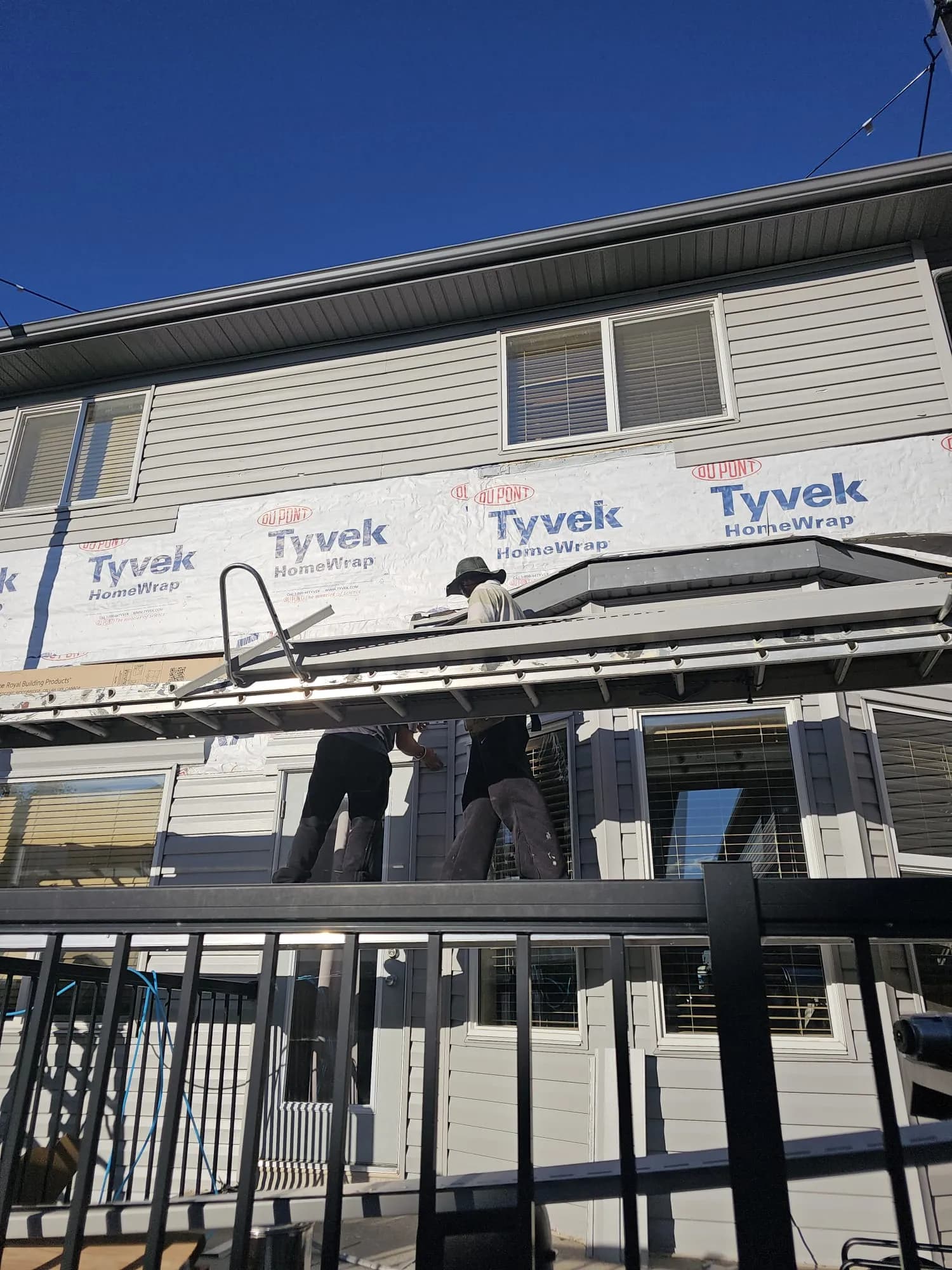
As with roofing, the economics strongly favour doing it alongside the house. Staging, crew and material delivery are already mobilized during a house re-side, and the garage adds far less to that job than it costs as a standalone one — while guaranteeing the colours actually match, which they often do not when the two are done years apart.
The full guide
Everything worth knowing about garage siding in Alberta.
What we find behind old garage siding
The bottom of a garage wall is the wettest part of any structure on a residential property, and it is where nearly every problem we uncover lives.
Rotten sheathing along the base is the most common find, and the cause is almost always the absence of eavestrough combined with grade that has built up against the wall over decades. Water comes off the roof in a curtain, splashes back off the ground, and soaks the bottom of the wall on every rain for thirty years.
Rotten bottom plates follow from the same mechanism. The bottom plate is the horizontal member the wall studs sit on, fastened to the slab, and it is the first structural element to go. Replacing it is real work — the wall has to be supported while it is cut out and a treated plate installed — but covering it with new siding is a genuine structural compromise, not a cosmetic shortcut.
Missing or absent water-resistive barrier is nearly universal on older garages. Many were sheathed and clad with nothing between, on the reasoning that a garage does not need it. It does; a garage wall gets wet the same way a house wall does.
And door framing, which takes the most abuse of anything on the building. Overhead door jambs and service door frames rot at the base for the same reason the plates do, and they are worth addressing while the wall is open rather than after new trim is on.
None of this is exotic or unusually expensive to correct. All of it is very expensive to reach once new cladding is over it, which is the entire argument for a contractor who removes and inspects rather than one who quotes per square foot from the lane.
- Rotten sheathing along the bottom of the walls
- Rotten bottom plates where the wall meets the slab
- No water-resistive barrier behind the original cladding
- Rot at overhead and service door framing
- Grade built up against the wall over decades
- No eavestrough, and the erosion trench that comes with it
Matching the garage to the house
Matching is the whole point, and it is more than picking a similar colour.
The siding profile matters first — panel width and whether it is horizontal lap, Dutch lap, vertical or board-and-batten. A garage in a different profile reads as different even in the same colour, because the shadow lines are different.
Colour is second, and it is where doing the work in the same season as the house pays off. Vinyl colour formulations change, product lines get discontinued, and existing siding on the house has faded by an amount no colour chart accounts for. Matching a five-year-old faded wall from a current sample is genuinely difficult; matching two walls clad in the same month is trivial.
Trim is third and is what most people get wrong. Corner posts, window and door surrounds, and the frieze detail under the eave are what make an exterior look intentional. A garage with the right siding and generic trim still reads as an outbuilding.
Then the eave line: soffit, fascia and eavestrough in the same colour family as the house, which is the detail that ties the two structures together visually more than the wall colour does.
Where an exact match is not achievable — because the house siding is old or discontinued — the better answer is usually a deliberate complement rather than a near-miss. A garage in a related accent colour with matching trim looks designed; a garage two shades off the house looks like a mistake.
Vinyl or Hardie on a garage?
The same trade-offs as on a house, weighted slightly differently.
Vinyl and insulated vinyl are the common choice, and for good reason: a garage is a large simple area with few openings, which is exactly the geometry where vinyl is fastest and most economical. Insulated vinyl is a meaningful upgrade on a garage specifically because garage walls take more impact than house walls — from vehicles, bikes, ladders and hail — and the foam backing raises impact resistance considerably.
James Hardie makes sense on a garage in three situations. When the house is already clad in Hardie and matching matters. When the garage sits close to a property line or another structure, where non-combustible cladding is worth having and in some cases required by setback-related fire provisions. And on acreages in the wildland-urban interface — Bragg Creek, Priddis, Millarville, Springbank, Canmore — where the whole property benefits from non-combustible exteriors.
The practical caution with Hardie on a garage is the same as anywhere: it is unforgiving of installation shortcuts, and it needs specified clearance from grade. Garage walls are closer to grade than house walls and are more likely to have snow banked against them all winter, which makes that clearance more important rather than less.
For most Calgary lane garages, our recommendation is insulated vinyl in a profile and colour matched to the house, with matching aluminum soffit and fascia and seamless eavestrough. It handles the impact, matches cleanly, and puts the money where it does the most visible good.
Hail, insurance and garage cladding
Garage siding is left off hail claims even more often than garage roofs are, and for the same reason — nobody inspected it.
The damage pattern is the same as on a house: hairline cracks and punctures in vinyl, concentrated on the elevation facing the storm and usually low on the panel where it is least supported. On an older garage clad in thin builder-grade vinyl that has spent twenty years in high-altitude UV, the material is brittle enough that a moderate storm does real damage.
The garage door is the other component worth documenting. It is a large flat sheet of soft metal, it dents visibly, and those dents are among the most persuasive corroborating evidence an adjuster can have that a hail event of a given stone size actually occurred at your address. Even if the door itself is not being claimed, photographing it supports the rest of the claim.
We inspect the garage — roof, walls, door, soffit, fascia and eavestrough — at the same time as the house, and put everything in one scope. One contractor documenting an entire property is materially easier for an adjuster to work with than several trades submitting separately, and it means you do not end up with a restored house beside an untouched garage.
Garage siding across Calgary and Central Alberta
Most of this work is in Calgary's lane-access neighbourhoods, where the garage is highly visible from the lane and often from the street on a corner lot — Bowness, Renfrew, Killarney, Inglewood, Ramsay, Mount Pleasant, Bridgeland, Highland Park, Marda Loop, Altadore, Capitol Hill, Tuxedo Park, Crescent Heights. Those garages are old enough that the cladding is original, and the difference a re-side makes to the back of the property is dramatic.
In the suburbs and surrounding towns the driver is usually a mismatch: a garage built later than the house, or re-clad at some point in a colour that no longer relates to anything. Airdrie, Chestermere, Cochrane, Okotoks, Langdon, Strathmore, Crossfield, Carstairs, Didsbury, Olds, Innisfail and Red Deer all see plenty of it.
On acreages the work extends to shops, barns and outbuildings, where the exposure is the deciding factor. A structure with no windbreak takes driven rain and snow directly into the wall assembly, and the flashing detail and fastening frequency both matter more than they do on a sheltered city lot.
Wherever it is, we do the same three things: take the old cladding off and look at what is behind it, fix what the water has done, and finish the building so it matches the house rather than announcing that it was done separately and cheaply.
Garage Siding across Calgary & Central Alberta
Plus: Acme, Aldersyde, Ardenode, Arrowwood, Balzac, Banff, Bassano, Benchlands, Bergen, Black Diamond, Blackfalds, Blackie, Bottrel, Bowden, Carbon, Caroline, Carseland, Cayley, Champion, Cheadle, Claresholm, Cluny, Cochrane Lake, Conrich, Cremona, Dalroy, Dead Man's Flats, Delacour, Delburne, Dewinton, Dickson, Dogpound, Eckville, Eden Valley, Elbow Valley, Elnora, Ensign, Exshaw, Ghost Lake, Gleichen, Harmony, Harvie Heights, Heritage Pointe, Hussar, Huxley, Indus, Irricana, James River Bridge, Janet, Kananaskis Village, Kathyrn, Lac des Arcs, Linden, Longview, Lyalta, Madden, Markerville, Millarville, Milo, Morley, Morrin, Mossleigh, Munson, Namaka, Nightingale, Parkland, Penhold, Pine Lake, Priddis, Priddis Greens, Queenstown, Red Deer Lake, Redwood Meadows, Rocky Mountain House, Rockyford, Rosebud, Siksika Nation, Springbrook, Spruce View, Standard, Stavely, Swalwell, Torrington, Trochu, Tsuut'ina Nation, Turner Valley, Vulcan, Waiparous, Water Valley, Wimborne — and the surrounding Rocky View, Foothills, Mountain View, Wheatland, Kneehill and Red Deer county acreages.
Questions
Garage Siding & Exterior Finishing FAQ
How much does it cost to re-side a garage?
+
It depends on the size of the building, the material you choose, and what the tear-off exposes — rotten sheathing and bottom plates are common on garages with no eavestrough, and they need real repair rather than covering. Bundled with a house re-side it costs considerably less, because staging, crew and material delivery are already mobilized.
Can you match my garage siding to my house?
+
Yes, and it is the main reason to use one contractor for both. Profile, colour, trim, soffit, fascia and eavestrough all get matched. Doing both in the same season makes matching straightforward; doing them years apart is genuinely difficult because colours get reformulated, lines get discontinued, and the existing wall has faded.
What's behind my old garage siding likely to look like?
+
On a garage without eavestrough, usually rotten sheathing along the base and often rotten bottom plates where the wall meets the slab — decades of roof runoff splashing back off the ground. Most older garages also have no water-resistive barrier at all. We open it up and show you rather than quoting a wrap over unknown wood.
Should I use vinyl or James Hardie on a garage?
+
Insulated vinyl for most Calgary lane garages — a garage wall takes more impact than a house wall, and the foam backing raises impact resistance considerably. Hardie makes sense when the house is already clad in it, when the garage sits close to a property line where non-combustible cladding matters, or on foothills and acreage properties where wildfire is a consideration.
Do I need eavestroughs on the garage?
+
If it does not have them, that is almost certainly what caused the rot we will find at the bottom of the walls. Adding seamless eavestrough with a downspout and an extension is a small cost and it stops the same damage starting over on new cladding.
Was my garage siding damaged by hail?
+
Quite possibly, and it is left off claims even more often than the garage roof. Look for hairline cracks and punctures low on the panels on the storm-facing elevation — they only show in raking light. The garage door is worth photographing too: it dents visibly and is strong corroborating evidence for the whole claim.
Can you replace rotten bottom plates?
+
Yes. The wall gets supported while the rotten plate is cut out and a treated plate installed. It is real work, but siding over a rotten bottom plate is a structural compromise, not a cosmetic shortcut, and it is the one thing on this job we will not skip.
Do you do the soffit, fascia and trim as well?
+
Yes, and the eave line matters more than the wall colour for making the garage look like it belongs. Matching soffit, fascia and eavestrough is what visually ties the two structures together.
Can you side a shop or acreage outbuilding?
+
Yes. Exposure is the deciding factor out there — a structure with no windbreak takes driven rain and snow straight into the wall assembly, so we specify heavier fastening and closer attention to flashing than a sheltered city lot needs.
Should I do the garage siding and roof at the same time?
+
If both need doing, yes. One mobilization, one crew, matched materials, and the drip edge, fascia and eavestrough all set up as one system rather than three visits. It is cheaper and it produces a better result.
Related services
We also handle
Our work
Garage Siding & Exterior Finishing & more
Free inspection
Get your garage siding quote
No pressure · No surprises
Ready to move on your garage siding project?
Free on-site inspection, honest written quote, and full insurance-claim support if you need it.